He Released 50 Wild Animals From His Private Zoo Into The Community On Purpose
The infamous case of the zanesville massacre

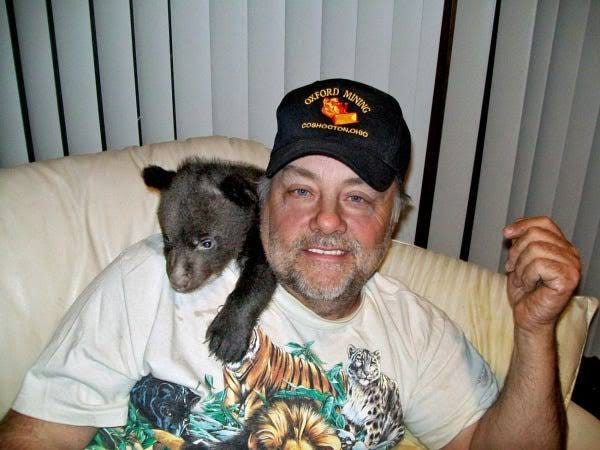
In July 2011, a small town in Ohio experienced something extremely traumatic. And it all happened due to the actions of a man who owned more than 50 exotic wild animals.
Residents woke up to tigers and bears running wild all over the streets. They got an even bigger shock when they discovered that the whole incident wasn’t due to the man’s negligence or the animals breaking out themselves. It was much worse.
The eccentric rich man had set the animals free to ravage the community on purpose. But was it due to a mental illness? Was it just a huge middle finger to the community? How many people were killed? And what happened to him afterwards?
Terry Thompson was born in 1949 and grew up in Zanesville, Ohio. He was known for his insane exotic animals collection. His wife, Marian loved horse riding and was also a school teacher.
The locals knew him, zanesville isnt exactly a large town. Apart from his exotic animals, he was also known by locals as the man who flew a small plane under the Y bridge. He was that eccentric.

As a young man, he joined the military and served as a helicopter pilot during the Vietnam War. His time in the war affected him deeply, and friends later said it changed him as a person.
After returning home, Thompson settled in Muskingum County, Ohio, and began building a life centered around his passions for animals, firearms, and aviation.
In 1977, Thompson started his journey with exotic animals when he bought a lion cub named Simba as a birthday gift for his wife, Marian.
This marked the beginning of his lifelong interest in collecting and raising exotic animals, such as lions, tigers, bears, and wolves. Over the years, his collection grew to include dozens of animals, which he kept on his 73-acre property in Zanesville.
And these animals were everywhere. In fact, the sherrif said upon inspection, he found out that the animals were scattered all over his house. Tiger cages in the garage, a puma in the bedroom, on the bed. Monkeys in the basement. Just everywhere.
Thompson told the Zanesville Times Recorder in 2008 that he loved his animals and was willing to do whatever it took to care for them. He said he had seven veterinarians on call and did not keep the animals for profit but because of his deep affection for them.
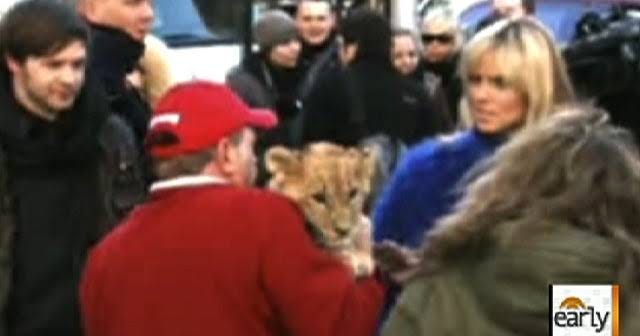
He also worked as an animal handler, including a stint on the television show *Wild Kingdom* in 2008, and provided a lion cub for a photo shoot with supermodel Heidi Klum.
Thompson’s professional life was varied. He owned two Harley-Davidson dealerships and a beer-and-wine carryout in Zanesville, which gave him the financial means to support his animal collection.
He also ran a small business, selling motorcycles and scooters from his property. As a licensed pilot, Thompson owned several small aircraft and maintained a grass airstrip on his land for takeoffs and landings.
His love for firearms led him to become a federally registered firearms dealer, and he amassed a collection of guns, including automatic weapons and sniper rifles. However, his gun dealings got him into legal trouble.
In June 2008, federal agents raided his property and seized 133 firearms, including five unregistered automatic weapons and three sawed-off shotguns.
In October 2010, Thompson was sentenced to a year and a day in federal prison for possessing unregistered machine guns. He served his sentence and was released to a halfway house in August 2011, returning home on September 30, 2011.
Thompson faced other legal issues over the years. In 2005, he was convicted in Muskingum County Municipal Court of cruelty to animals, having an animal at large, and two counts of rendering animal waste without a license.
These charges came after three dead cows and a bison were found on another property he owned in Perry Township, east of Zanesville. He was fined $2,870, put on house arrest for six months, and ordered to move his animals to his Kopchak Road property.
Neighbors often complained about his animals escaping due to improper fencing, and the Muskingum County Sheriff’s Office responded to more than 30 calls about Thompson’s animals in the five years before the incident.
In 2008, authorities investigated reports of animal abuse and public safety violations at his farm, citing dilapidated enclosures and animals lacking food or water, but they found insufficient evidence to convict him.
Financially, Thompson struggled in the years leading up to 2011. Court records show that he and Marian owed at least $68,000 in unpaid income and property taxes, including $55,695 to the Internal Revenue Service, which filed liens against them in 2010.
They also faced thousands of dollars in court judgments for other unpaid debts. These financial pressures worsened while Thompson was in prison, as Marian struggled to maintain the farm and care for the animals alone.
Friends said the costs of feeding and caring for the animals, along with legal fees, nearly broke Thompson.
On a personal level, Thompson’s marriage to Marian faced challenges. The couple, who had been together for decades, reportedly separated before the incident.
Friends noted that Marian was not at the farm on October 18, 2011, and was out of town on business. Thompson’s time in prison and the strain of their financial and legal troubles likely contributed to their estrangement.
Despite these difficulties, Thompson remained devoted to his animals, which he and Marian treated like family.
The farm was home to a wide variety of exotic and dangerous animals.
According to the Muskingum County Sheriff’s Office, the collection included 18 Bengal tigers, 17 African lions, six black bears, two grizzly bears, two wolves, one baboon, one macaque monkey, and nine male giraffes.
Thompson acquired some animals from dealers or auctions, while others, like bear cubs, were reportedly taken in after being rejected by their mothers at zoos. He also bred some animals, such as lion and tiger cubs, which he occasionally sold or provided for events.
The animals were kept in a mix of cages and enclosures scattered across the property. Some were housed in metal cages, described as small and cramped, while others were in larger pens with chain-link fencing.
A few animals, like the giraffes, had more open space, but the enclosures were often criticized for being inadequate. Neighbors and authorities reported that the fencing was not strong enough to contain large predators like tigers and lions, and some cages were in poor condition, with rust and structural damage.
A 2008 inspection by the Ohio Department of Agriculture noted dilapidated enclosures and concerns about animals lacking proper food or clean water. Thompson claimed he had seven veterinarians on call to care for the animals, but reports suggested that veterinary care was inconsistent, and the animals’ health varied.
Over the five years before the 2011 incident, the Muskingum County Sheriff’s Office received more than 30 calls about Thompson’s animals. Neighbors reported animals escaping, including a lion spotted on a road and a bear found on nearby property.
One neighbor, Cindy Huntsman, told the Zanesville Times Recorder in 2011 that a lion had killed her horse years earlier, and she lived in fear of the animals getting loose. Others complained about the noise, particularly the roars of lions and tigers, which could be heard at night.
There was an even more chilling account from his neighbor, Sam Kopchak in October 2011. He noticed something strange while he was leading his horse to pasture. He took a closer look and what he saw was really horrifying.
Staring into his eyes was a huge black bear. His horse began panicking so he had to calm it down immediately. But that wasn’t even what horrified him at all.
Black bears typically do not attack and predate on humans. As a matter of fact, they’re shy and go out of their way to avoid confrontation with humans.
Lions on the other hand aren’t like that. They’re opportunistic and will not pass off the chance of an easy food.
A lion was in close, almost pouncing range, separated only by a fence it could effortlessly jump over.
Running away would have been the biggest mistake any person would ever make in that situation. Sam knew this very well and began moving backwards slowly while maintaining eye contact.
He was lucky enough to make it home with his horse and lock himself inside. He called his mom, who then decided to call thompson. However, she was met with the answering machine. This was when she decided to call the authorities.
Thompson seemed to have bitten off more than he can chew. He had this huge responsibility without the means to carry them out.
He was facing thousands of dollars in court judgments for other unpaid debts. Maintaining the animal farm was costly, with expenses for food, veterinary care, and enclosure repairs adding up quickly.
Feeding the 56 exotic animals, including 18 tigers and 17 lions, required substantial resources, with estimates suggesting it cost thousands of dollars each month.
While Thompson had previously earned money through his Harley-Davidson dealerships and a small motorcycle business, these ventures were no longer as profitable. During his prison sentence, Marian struggled to keep the farm running alone, and the couple’s financial situation worsened.
Thompson began to struggle with his mental and emotional state. He was dealing with the aftermath of prison, a failing marriage, and the threat of losing his animals. He was unraveling.
On October 18, 2011, a tragic and chaotic event unfolded at Terry Thompson’s animal farm.
The day began like any other at the farm, with no immediate signs of what was to come. Thompson’s wife, Marian, was out of town on business, and Thompson was alone at the property.
Sometime in the early afternoon, he used bolt cutters to open the cages and pens holding his animals. The released animals included 18 Bengal tigers, 17 African lions, six black bears, two grizzly bears, two wolves, and one baboon.
Six animals—three leopards, one grizzly bear, and two macaque monkeys—remained in their enclosures and were not released.
Around 5:30 p.m., the Muskingum County Sheriff’s Office received a call from a neighbor, Dolores Kopchak, who reported seeing a lion and a bear on her son Sam’s property next to Thompson’s farm. Yes, the Sam I referred to earlier.
The sherrif quickly dispatched deputies to the scene, and they confirmed that multiple exotic animals were loose. As more reports came in, it became clear that the situation was dire.
Animals were spotted along Kopchak Road, near Interstate 70, and in nearby fields. The sheriff’s office faced a major challenge: the animals were dangerous, it was getting dark, and the terrain was rugged, making it hard to track them.
As if it couldn’t get any worse, the sheriffs stumbled on something gruesome that would change the entire course of their operation.
In the process of trying to find terry thompson, the officers found a body laying in the field. Their priority was to determine the identity and whether or not it had been deceased.
As they moved closer, they heard a deep angry growl from the nearby trees. Almost in an instant, two fully grown tigers leapt out and began approaching them. The men were immediately instructed to put them down, which they did.
They got to the body and it was clearly deceased. The tigers had already started feasting on him. The men didn’t even have the time to be shocked because in a moments notice, two big cats were already escaping through the south side of the compound so they immediately had to go over there to put them down.
It was at this point the sherrif made the difficult decision to prioritize public safety and ordered deputies to shoot the animals on sight rather than attempt to tranquilize them.
The sheriff’s office lacked the equipment and trained personnel to safely capture so many large predators, and tranquilizers would have taken too long to work, risking further escapes or attacks.
Deputies, equipped with rifles and shotguns, began patrolling the area in pickup trucks, tracking the animals with help from neighbors’ reports.
Officers began engaging the animals at different distances. One of them talked about how a lioness saw him and dashed towards his direction. He had to shoot it severally before it crashed a few feet away from him.
By nightfall, the operation expanded, with additional support from the Ohio State Highway Patrol, the Zanesville Police Department, and animal experts, including Jack Hanna, director emeritus of the Columbus Zoo, who arrived later that evening.
As the animals spread out, the community went into lockdown. Schools in the Zanesville City and West Muskingum districts canceled classes the next day, and residents were told to stay indoors.
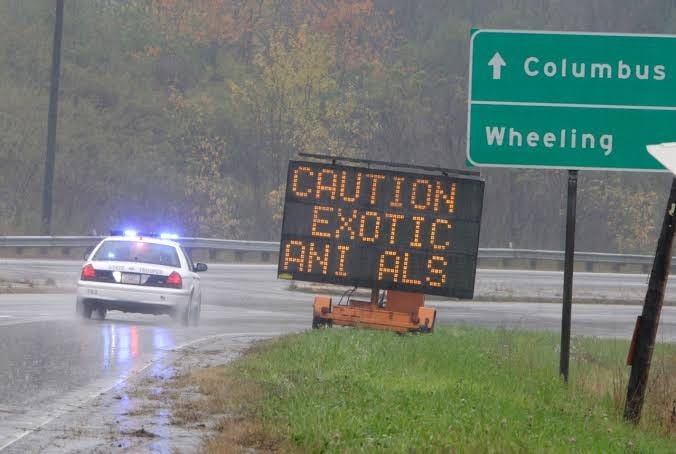
Signs were placed along Interstate 70 warning drivers of exotic animals, and a portion of the highway was briefly closed.
Deputies worked through the night, locating and killing the animals one by one.
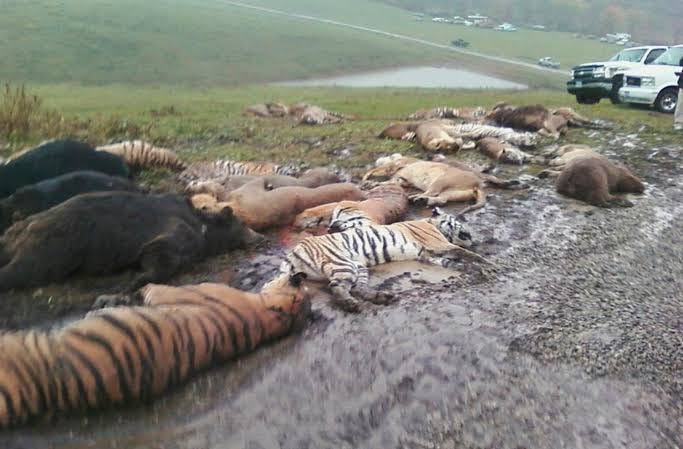
By the morning of October 19, 49 of the 50 released animals were dead: 18 tigers, 17 lions, six black bears, two grizzly bears, two wolves, and one baboon.
The baboon was killed by a veterinarian assisting the sheriff’s office, as it was deemed too dangerous to capture. One wolf was never found and was presumed to have been killed by another animal or died later. The six animals that remained caged were later transferred to the Columbus Zoo.
The community’s reaction was a mix of fear, shock, and sadness. Neighbors who had long complained about Thompson’s animals, like Cindy Huntsman, felt their worst fears had come true.
Many residents cooperated by reporting animal sightings and staying indoors, but some expressed anger over the animals’ deaths, wondering if they could have been saved.
Marian Thompson initially sought to reclaim the six animals, as they were legally her property.
The zoo, under Ohio Department of Agriculture oversight, held the animals while legal proceedings took place. In December 2011, a judge ruled that Marian could take the animals back if she met new state requirements, such as obtaining a permit and improving the farm’s enclosures.
The zoo complied with the court order, and the animals were returned to Marian in 2012 after she met the conditions. The Columbus Zoo ensured the animals were healthy before their release and continued to monitor the situation indirectly through state inspections.
In all this, you might be asking what happened to Thompson and how many years he was sentenced behind bars, for endangering the lives of thousands of people and causing the deaths of over 40 exotic animals, right?
Well, apparently After freeing the animals, Thompson went to a wooded area near the farmhouse and shot himself with a handgun.
His body was later found by deputies, surrounded by several animals, including a tiger that was feeding on him.
What do you think? Was Thompson a man who never cared about animals to begin with? Or was he just an overzealous animal lover who took up more responsibilities than he could handle, and broke down.
This is the first time I've heard about this story - thanks for sharing! Very interesting and a tragedy for all those affected.
I do remember this story. PROFOUNDLY disturbing. This "animal lover" should have NEVER been allowed to horde ANY animals, most definitely NOT giant carnivores like lions, bears, tigers. There is just no scenario where one flaky weirdo & his equally reality- challenged spouse could have provided adequate habitat, food, medical care sufficient to meet these helpless beasts' needs at all. Then to compound everything ×10 by releasing most of the menagerie into the city/county to run wild, panicked, NEVER properly cared for, and terrified-- this is criminality of an order of magnitude beyond reckoning. The ONLY response was to ELIMINATE the public threat these tragic animals posed, and shoot them before they killed pedestrians or ran onto highways.
If this kooky owner had been growing marijuana, every law enforcement agency would descend on him like "white on rice". Instead, he's allowed to acquire & grow this wretched penal colony of abused wildlife, and everybody shrugs and pretends it isn't there.
This should have NEVER been allowed to get this bad or go on for so long. Just like the horrific Travis the chimp story, private ownership of exotic wildlife is at best a public nuisance and has to be ILLEGAL. I'd go even further and say that people within city limits can have no more than 2 household pets, and rural/county residents more, subject to owner regulations we can't hang up on here. No one needs me to tell you that hundreds of thousands of domestic pets already suffer unspeakable neglect and abuse at the hands of their moronic or depraved "animal lover" owners.